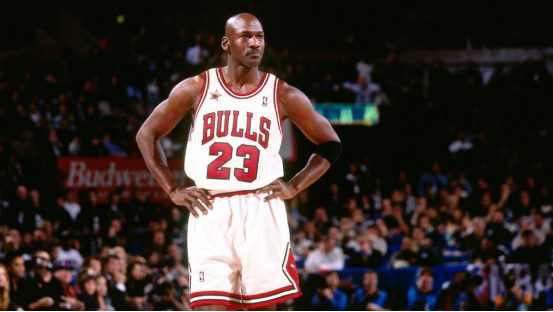
Introduction: Why did Jordan “not look strong” but still dominate an era?
In people’s stereotypes of athletes, dominant stars usually have explosive muscles and overwhelming physiques. However, for a long time in his career, Michael Jordan looked more like a “slender” athlete rather than a “muscle monster.” But it was this seemingly “light” body that supported his absolute dominance of the NBA in the 1990s.
So, what kind of physical qualities does this basketball god have? What do his physical data mean? This article will take you to systematically dismantle Jordan’s athletic talent and understand the true meaning of the word “talent” from a new perspective.
1. Hardware foundation: Behind the inconspicuous appearance is a perfectly proportioned body model
Michael Jordan’s official height is 1.98 meters, and his weight was about 100 kilograms at his peak, and he once weighed nearly 110 kilograms at his heaviest. His wingspan varies according to different data (such as 2.12 meters, 2.16 meters), but the more credible estimate is 2.18 meters, which means that his wingspan is a full 20 centimeters longer than his height.
For comparison and reference, the difference between Durant’s height and wingspan is about 22 cm, and he is called the “long-arm monster”; Jordan’s wingspan is also top-notch in body proportions, giving him a natural advantage in blocking, defending and shooting space.
2. Palm talent: Control the game from one hand
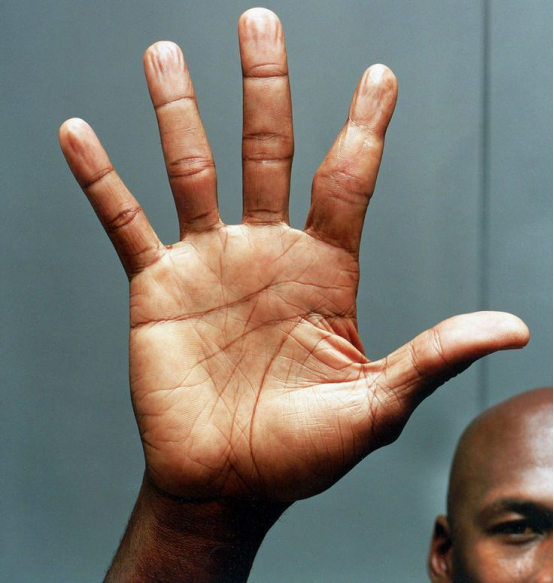
Jordan’s hand size is also amazing. Its palm length is 24.8 cm, and its width is 28.9 cm, which is larger than the legendary center Chamberlain who is 2.16 meters tall. In NBA history, Jordan’s palm size ranks eighth, and considering that his overall body is not “giant”, this data is particularly rare.
The big palms not only bring a visual sense of oppression, but also the control over the ball in actual combat – whether it is catching the ball with one hand, dribbling with a change of direction, or flying dunking, there is more room for error.
3. Achilles tendon and jumping: Why can Jordan “hover” in the air?
Jordan’s Achilles tendon is 28.3 centimeters long, which ranks fifth in NBA history, only 6 centimeters away from the top of the list, “Antetokounmpo”, who is a full 15 centimeters taller than Jordan. A longer Achilles tendon often means stronger explosive power and jumping ability.
According to unofficial statistics, Jordan’s vertical jump is about 96 cm, and his running jump limit is 121.9 cm. Although some of the data has not been authoritatively verified, relatively conservative estimates also show that he can easily reach a height of 3.78 meters, which is comparable to Howard and other inside monsters.
Even more amazing is his “air control time” – up to 0.92 seconds, almost the longest in NBA history. Because of this, Jordan can always complete his moves while hanging in the air when people think he should land. Those classic “air walk” and “hand-to-hand pull-up” scenes are so deeply rooted in people’s hearts.

4. Speed and strength: Not a sprinter, but fast enough and strong enough
Regarding Jordan’s speed, there are rumors that he can sprint 100 meters in 10.7 seconds, but more credible analysis believes that it should be between 11 and 12 seconds. Even so, this is far beyond the level of most NBA players. You know, the world record in the 1990s was only 9.90 seconds.
In terms of strength, the most widely circulated “200 kg bench press” is probably a misunderstanding. According to the documentary “The Last Dance”, Jordan’s maximum bench press during training was 235 pounds (about 107 kg), which is a high standard for players, but not abnormal. Rather than saying that he is a power monster, it is better to say that he has the most reasonable ratio of strength to speed.
5. Core and coordination: Those seemingly easy movements are actually extreme control
Jordan is known as the “Flying Man” not only because he can jump high and stay in the air for a long time, but also because he can perform complex and smooth movements in the air. His waist and abdominal core strength is so strong that it can almost be called an art level: from the stability of the fadeaway jump shot to the ability to change the pull-up layup, every detail is the ultimate embodiment of body coordination.
While other players were still adjusting their center of gravity in the air, Jordan had already completed changing hands, pulling the lever and even changing direction twice – this kind of control has rarely been replicated to this day.
Conclusion: Jordan’s body is not “superhuman”, but it was born for basketball
In today’s league, we see more and more talented players: taller, faster, stronger. However, the reason why Jordan’s body is known as the “basketball template” is not that he has extreme single data, but that he combines various qualities in the most coordinated way, reaching an ideal state that is almost tailor-made for basketball.
Perhaps we can ask this question: If God were to design a human body that is “most suitable for playing basketball”, what would it look like? Jordan may be the one who is closest to the answer.
What do you think?
Do you think there is any other player in the NBA who can match Jordan in terms of physical talent balance? Feel free to leave your answer in the comment section, or forward it to your “God of Basketball” supporters!