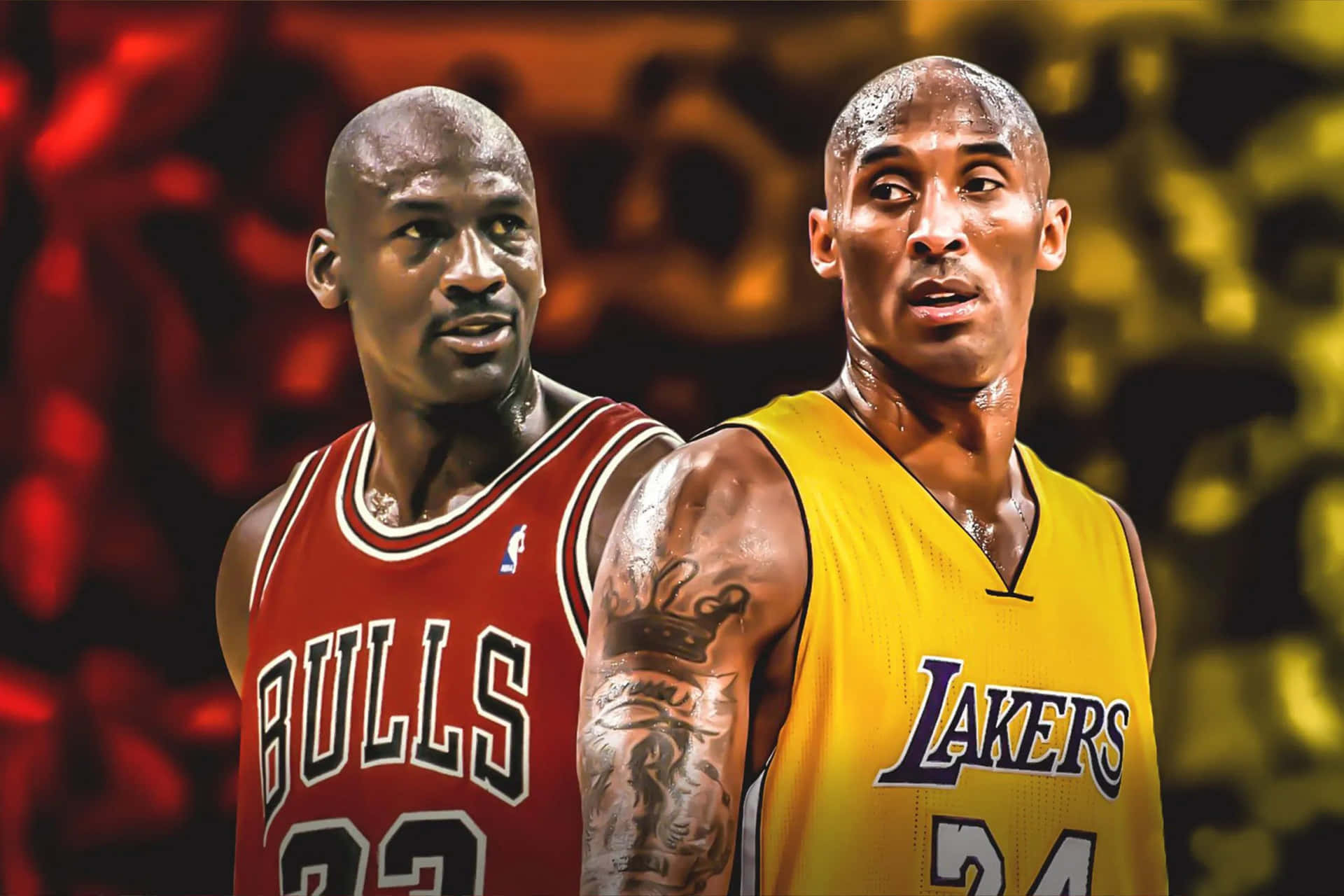
People often say that Kobe was the closest to Jordan —their skills, posture, and even temperament were so similar. However, why did Kobe, “like a god,” ultimately fail to become the “god” himself?
This isn’t a question that can be explained simply by saying “Jordan was better.” To understand the true differences between the two, we must re-analyze this cross-generational rivalry from the perspectives of physique, technique, and even mentality.
I. Difference in Talent: Subtle physical differences determine the direction of play.
From a static perspective, Jordan and Kobe are almost mirror images:
Height : Both are 6 feet 6 inches (approximately 198 cm) with shoes on.
Wingspan : Jordan approximately 214cm, Kobe slightly shorter at approximately 211cm;
Vertical reach : The two were almost identical, with a difference of only 1 centimeter;
However, one key metric— hand size —became the most influential detail in the difference between the two. Jordan’s hands were significantly longer and wider than Kobe’s, allowing him to control the basketball more firmly and making him more adept at starting, changing direction, adjusting in the air, and using fakes.
This isn’t just a matter of grip strength. Larger hands allow the fingers to act as levers, harnessing the power of the shoulder and core, making Jordan’s shooting and drives much easier and more natural. Conversely, Kobe’s smaller hands forced him to rely on more complex footwork and rhythm changes to create space. Thus, we see:
Jordan could easily get rid of the defense with a fake move or a shoulder shake ;
Kobe, on the other hand, often needed to use a series of changes of direction, spins, and fadeaways to create shooting opportunities.
This is why Jordan’s playing style appears relaxed and effortless , while Kobe’s playing style often carries a touch of “toughness” and stubbornness .
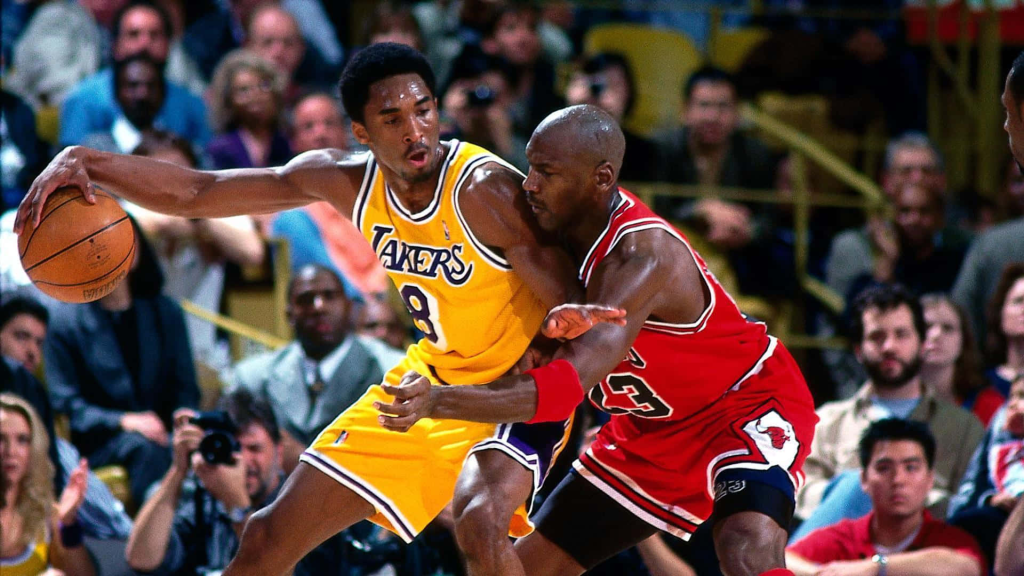
II. Divergent Technical Philosophies: Before vs. After Ball Control
The two players’ skill sets reflect their different understandings of basketball.
Jordan’s core was ” control before receiving the ball “—he used off-ball movement, positioning, and rhythm to create the best shooting opportunities for himself.
Kobe, on the other hand, focused on ” control after receiving the ball “—he used footwork, body movement, and feints to defeat his opponents.
Jordan’s way:
Before cutting to the basket or receiving the ball in the low post, Jordan would subtly lower his shoulders, position himself, and change his rhythm to gain an offensive advantage the moment he received the ball. At this point, he didn’t need complex footwork; a simple fake or triple-threat pose was enough to easily score.
Kobe’s way:
Kobe’s offense was more like the sculpting of a work of art. Because he couldn’t control the ball as completely as Jordan, he had to use the ultimate details of his footwork— spins, crossovers, fadeaway jumpers —to create space. This made his movements more complex and more visually appealing.
This is why Jordan’s basketball seems more “divine,” as if he is “choosing to score”;
while Kobe’s basketball is more “human,” full of confrontation, will, and indomitable spirit.
III. The Art of Back-to-Back Stance: Different Interpretations of Strength and Skill
Jordan and Kobe’s post-up game is almost a landmark in basketball history.
But even though the moves are similar, the core concepts are completely different.
Jordan tended to solve problems with minimal movements —a feint, a lateral shift, and a quick rise.
Kobe, on the other hand, constantly probed with variations—half-turns, step-backs, reverse turns, his footwork as solid as a dancer’s.
This difference stems from the different ways the two utilized their physical advantages:
Jordan used his strong shoulders and hang time to easily create space laterally ;
Kobe, on the other hand, relied on footwork and upper body rigidity to force his way through the defender and take a shot .
This is not only a difference in physical structure, but also a reflection of mental attitude: Jordan suppressed his opponents with elegance , while Kobe conquered his opponents with fighting spirit .
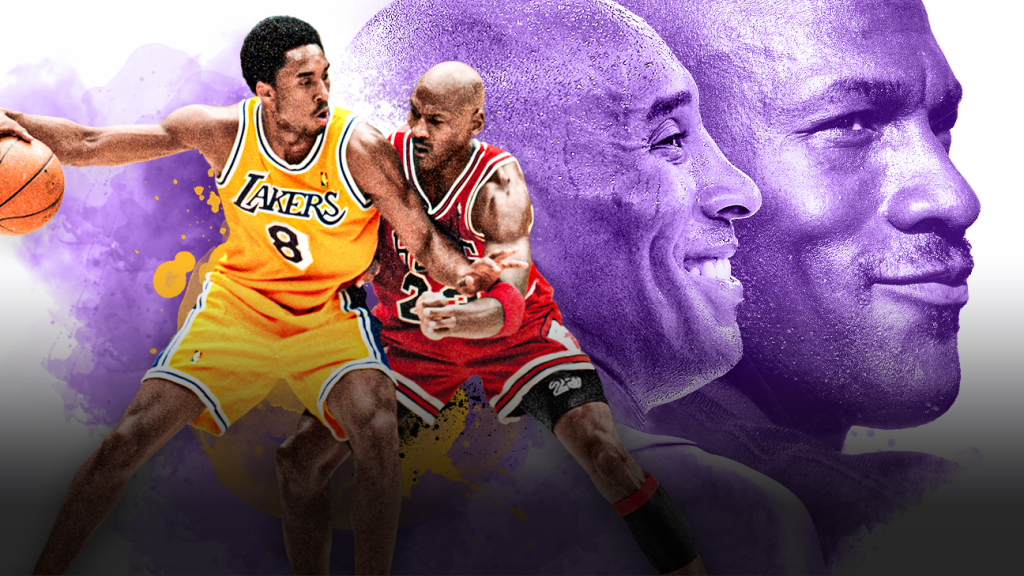
IV. The Spiritual World: From “Giving and Taking” to the “Mamba Mentality”
Beyond the competitive aspect, the biggest difference between the two lies in their inner spirit.
Jordan was like a god—overlooking everything and controlling the rhythm; his goal was to ” be the best .”
Kobe was like a warrior—giving his all in every battle; his goal was to ” never give up .”
Jordan often displayed a sense of composure and superiority on the court—he always seemed to know how to solve any problem against any defense;
Kobe, on the other hand, had an obsession—even if his shooting percentage was low and the opponent was stronger, he would still win the game in the toughest way possible.
He personally named this spirit ” Mamba Mentality “:
“No matter who we face, no matter what the outcome, we must fight with our strongest spirit.”
If Jordan represented “perfect power,” then Kobe represented “unstoppable humanity.”
V. The Origins of Basketball Philosophy: System and Lone Courage
Michael Jordan came from the basketball powerhouse University of North Carolina, where he was mentored by legendary coach Dean Smith.
He deeply understood the importance of system basketball—when Phil Jackson introduced the “triangle offense,” Jordan did not resist it; instead, he realized that
the team structure could extend his peak performance and reduce the physical burden on him.
Kobe, who grew up in Italy and whose father was a professional basketball player, had a more individualistic view of basketball—
leaders must lead by example and use their individual abilities to motivate the team.
Every offseason, he would readjust his shooting form to address changes in his body, a dedication that made him one of the most hardworking players.
Therefore, the two represent two different basketball philosophies:
Jordan-style perfectionism : using the system as the backbone and talent as the blade.
Kobe-style lone-wolfism : fueled by diligence and driven by willpower.
Conclusion: God and God of War—Two Paths to the Pinnacle
Jordan and Kobe, one is a “god who can get whatever he wants ,” the other is a “war god who never backs down.”
Their difference lies not in the level of their achievements, but in the direction of their spirit.
Jordan was like an eagle soaring high in the sky, elegant yet deadly;
Kobe was like a shark swimming against the current, tenacious and persistent.
Perhaps greatness takes more than one form.
It is precisely because Kobe was not as “transcendent” as Jordan that he showed us the full extent of human effort when approaching perfection.
Here’s the question for you:
If Jordan represents the “ultimate talent” and Kobe represents the “limit of will,”
which kind of “greatness” would you rather be?